Saturday, October 30, 2004

[COMPETITION] Ghouls With Attitude Volume 1 & 2

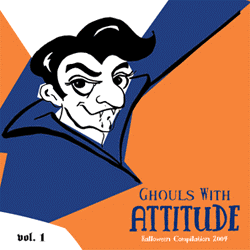
Happy Halloween! We came across these great compilations of Ghoulish oldies being served up for Hallow's eve by Oddiooverplay. They are two cds with over 50 tracks of great music inspired by everything sinister and evil but fun and playful about Halloween. Much props to Otis Fodder and the other contributors to this project. Competition: Seeing as how this comp has tons of oldies with tons of potential breaks and loops we decided to host a small competition. We want all the talented producers out there to make a hot Halloween Instrumental using samples from the tracks. We'll be accepting submissions for the next few days and then we'll post the best three. After that we'll have a small vote and the winner will get a free copy of Dj Signify's Teach The Children Vol. 1. If there's any interest just send audio or links to people@grandgood.com or better yet just post them through the comments option of this post. If there is no interest at least enjoy the music and play some tracks in between Eminem's Mosh and Snoop's Drop It Like It's Hot at your Halloween party! Enjoy:

VOLUME 1 VOLUME 2

Friday, October 29, 2004

Historic Hip-Hop Culture Exhibit at the Schomburg Library

Got this press release in an email:
Hip-Hop Icon Easy A.D., Emcee for the Legendary Cold Crush Brothers, to Present Historic Hip-Hop Culture Exhibit at the Schomburg Library from 11/18/04 to 12/31/04 NEWSWIRE: (PRWEB) October 28, 2004 -- Hip-Hop Culture began in the South Bronx borough of New York City in the early ‘70s. Inner-city youth defined their existence and identified their purpose in life when they developed the arts of DJing, Emceeing, Breaking and Grafitti Art. Hip-Hop crews organized around these four artistic elements of Hip-Hop Culture. The Cold Crush Brothers was one of these groups that embarked on tours around the world, establishing Hip-Hop as a culture in France, Japan, Germany, Africa and elsewhere.One of the Emcees for Cold Crush and Hip-Hop Icon, Easy A.D., documented Hip-Hop’s history even while he was helping to make it. He and official Cold Crush photographer, Joey Conzo, are credited with preserving a vast storehouse of hip-hop artifacts which includes: photographs from 1979-1985 that depict Hip-Hop in its purest form, flyers from 1978-1985 that feature the different crews of that era, clothing/fashion, trophies, books, contracts and royalty statements.At the close of this historic presentation, the featured artifacts will become part of a traveling exhibit. Easy A.D. also serves as the Vice-Chairman of the Board of Advisors for the new 24-hour cable network devoted exclusively to Hip-Hop, the Real Hip-Hop Network. For information: http://www.hiphophistorian.com/ or http://www.coldcrushbrothers.com/

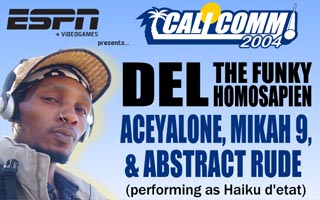
Del, Aceyalone, Abstract Rude, Mikah9 in NYC

All of them will performing at BB King's on 42nd street on Monday November 1st. LINK

Saturday, October 23, 2004

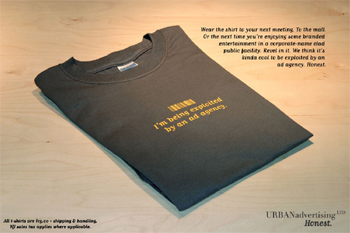
HipHops New T-Shirt

Thought I saw HipHop walking around the other day wearing this T-shirt, turns out it was just a perpetrator.

Friday, October 22, 2004

Confronting Big Payola: A Little Too Late?

NY State attorney general Eliot Spitzer is still making enemies. After b*tch-slapping the mutual-fund industry for giving preferential treatment to big money and screwing small-time investors and after very recently stepping up to the giant insurance brokers who direct client's to the biggest commission-paying insurance company instead of the one offering best terms, Mr. Spitzer is now getting ready to set the record (business) straight. As most industry heads know, if you want to get a radio dj to spin your artists' single (or should I say pop the cd into the disc changer?) you have to have the money or props to influence them. At one time (which some would argue includes the present) radio programmers were so notorious for taking bribes that a federal law was passed, known as the payola statute, that prevented them from accepting any "gift" for including a particular song or songs on their playlist. In good form the industry was able to adapt and create a process wherein the radio station still received a payoff from "promoters" who were getting paid by the record execs. After a few decades of people lampin' and collecting paper for playing what people did not necessarily want to listen to, without feeling any heat, it seems the AG is finally ready to confront sophisticated bribery schemes: (peep excerpt)

Record Labels Said to Be Next on Spitzer List for Scrutiny

"Now he is casting his eyes on the music industry, particularly its practices for influencing what songs are heard on the public airwaves. According to several people involved, investigators in Mr. Spitzer's office have served subpoenas on the four major record corporations - the Universal Music Group, Sony BMG Music Entertainment, the EMI Group and the Warner Music Group - seeking copies of contracts, billing records and other information detailing their ties to independent middlemen who pitch new songs to radio programmers in New York State. The inquiry encompasses all the major radio formats and is not aiming at any individual record promoter, these people said. Mr. Spitzer and representatives for the record companies declined to comment. The major record labels have paid middlemen for decades, though the practice has long been derided as a way to skirt a federal statute - known as the payola law - outlawing bribes to radio broadcasters. Broadcasters are prohibited from taking cash or anything of value in exchange for playing a specific song, unless they disclose the transaction to listeners. But in a practice that is common in the industry, independent promoters pay radio stations annual fees - often exceeding $100,000 - not, they say, to play specific songs, but to obtain advance copies of the stations' playlists. The promoters then bill record labels for each new song that is played; the total tab costs the record industry tens of millions of dollars each year."

Monday, October 11, 2004

OVERCOMIN'

As I notice the underground overcoming the dwindling barriers of the music industry, I sit and ask myself, are we better off? By "we" I mean the listener, the consumer, the retailer, the producer, the party-goer, the hater, the rapper...the citizen. Are members of this expanding and boundary-less community becoming more or less satisfied? One of the most basic barriers to so-called success in this industry was/is money. But obviously money, in and of itself, is not what players need(ed). Rawkus needed to get national distro so they got with Rupert Murdoch's son. Wu-Tang needed to get manufacturing and promotion, so they got with Loud. But today these hurdles are becoming less awesome. Mass distribution for an independent artist is no longer an impossibility (although establishing control over the technology that makes it possible could be). A national and even international marketing effort is not necessarily a multi-million dollar effort, especially when you can reach your target market(s) through niche sites. And access to reasonable recording equipment is more practical than ever before, enabling artists to record in their living rooms or at the motel after the show. I know it's hard to quantify "happiness" and things of that nature, but let's generalize for the argument's sake. Much like economists try to measure quality of life by jobs, disposable income, life span etc., can we as a community expect to see more accessibility to 1000-copy-runs of music, more convenient and suitable show venues, more media outlets and more interest by the hordes of consumers out there? Or, is what we are witnessing some kind of trend towards market-saturation consisting of weak material being presented by a bunch of perpetrators? Over the passed few days I've stumbled upon a good amount of music I'm enjoying and it has made me, at least temporarily, optimistic. The reason I'm rambling on about this is because, even as I get older and less idealistic, it's nice to know I am still susceptible to the power of music. I still bop my head uncontrollably when I hear a dope beat drop for the very first time. I thought I'd share: De La Soul - Rock Co. Kane Flow featuring Doom Handsomeboy Modeling School - The World's Gone Mad featuring Del Typical Cats - Justice Coming TOCA - Joyful Misery Sage Francis - Slow Down Ghandi Saul Williams - Black Stacey Shyheim - New Producers Even though I know a lot of people won't feel these tracks the same way I did when I first heard them, at least the potential for something is there. This can't be a bad thing. And since I'm well aware of the fact that my optimism will eventually fade and swing back towards the darkside, I and the other people at GrandGood have decided to force ourselves to make a post at least once a month featuring music that we like. All these low-fi real audio samples can only be available for thirty days, so as not to a) Annoy any artists or audio-hound sites and b) Annoy our website's host. Too bad we can't post mp3s, maybe in the future. Chill
President Shawn Carter

Although nothing is certain yet, there is a chance that Jay-Z might become president of Def Jam Records. It seems Universal is trying to woo Mr. Carter to head the label in order to secure some street-cred and keep the hits coming. You can read the full article at NYTimes (free registration required).

Universal Music, part of Vivendi, is set to pay about $10 million to unravel the partnership in Roc-A-Fella, which has provided the label with a series of platinum-selling hits, most recently Kanye West's "College Dropout." While there is a chance the talks could unravel, these people said, they expect a deal would be made before the expiration of the venture agreement at the end of February.

One twist to the negotiations is the future plans of Jay-Z, whose real name is Shawn Carter. He has said he is retiring from making albums, a proclamation he has made numerous times before. If he did record new music, he would be under contract to release it through Universal. But he is free to strike a deal for the creation of a new start-up label or take an executive post with any music company, and at the moment he is being hotly pursued by both Universal and a rival, Warner Music Group. (Executives from both companies have recently paid visits to Mr. Carter while he is on tour with the R&B star R. Kelly.)

Major record companies routinely reward or placate top recording artists by agreeing to finance their own small labels, like Madonna's Maverick Records (since bought out by Warner). Few, however, have turned out to be little more than vanity projects that are quickly forsaken.

In Mr. Carter's case, however, Universal would hand him the vacant position as chief of one of its biggest divisions, with authority over everything from album production to marketing strategies, and an artist roster that includes acts like LL Cool J and Ludacris. (After taking full ownership of the Roc-A-Fella venture, the company would also probably provide Mr. Carter with a new mini-label, tentatively called S. Carter Records.)

Friday, October 08, 2004

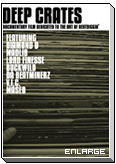
Deep Crates

Beatdawg released this DVD back in June but this is the first time I'm hearing about it. It claims to be a documentary about record diggin' and judging from the preview it might be worth the doe.

Sunday, October 03, 2004

And You Don't Stop

Sometimes I miss having cable television. Ever since being bought out by VIACOM and basically becoming another arm of almighty MTV, VH1 has begun to provide content a litte bit more in tune with popular culture. Below is an excerpt from an article describing a five part series dedicated to hip-hop. By the way, towards the end I think Lisa might have meant to write "In fact, we learn early on that the lesser-known Sugarhill Gang ripped off the ubiquitous "Rapper's Delight" from the almighty Cold Crush Brothers, but the beef was kinda, sorta set aside in the interest of spreading the word on hip-hop." Where's an editor when you need one?

It's a remix of hip-hop history "The first two of the five parts were provided for review, and it begins with Monday's show, "Back in the Day." Our first glimpse is of the Bronx in the late '70s, mired in poverty and drugs, broken like the smashed windows of its tenements. But in the desolation, here's a bunch of guys at block parties finding something to go crazy about with a couple of 12-inch records, a mike and a dance floor. A viewer's first impression is how far things have come, and you wish yourself into those crowds, feeling that brand-new, palpable energy coursing through the room. But Simmons interlaces the energy with stark reminders of the challenges. While we see Kool Herc and Afrika Bambaataa sowing seeds of party songs and positivity, we also see what gave rise to the socially conscious rap of Public Enemy......Knowledgeable fans will surely feel more obscure groups were slighted in favor of the big names. In fact, we learn early on that the Sugarhill Gang ripped off the ubiquitous "Rapper's Delight" from the lesser-known Cold Crush Brothers, but the beef was kinda, sorta set aside in the interest of spreading the word on hip-hop. It's these almost-contradictions that mark much of what Simmons is trying to say: that hip-hop succeeds in spite of, and because of, conflict, and tells a story of urban, black America — like it or not."